


Contents
Sungrow says its grid-scale battery energy storage system (BESS) PowerTitan 3.0 has passed a large-scale fire test on the first attempt. Although the internal temperature of the ignited container reached 1,259.8°C, thermal runaway did not propagate to neighbouring containers or to the medium-voltage station.
According to the company, the test was carried out in line with the latest UL 9540A: 2026 and CSA/ANSI C800-2025 requirements. It was conducted by UL Solutions and witnessed by fire safety and risk engineering specialist Fire Risk Alliance (FRA), with fire protection engineering consultancy Jensen Hughes also involved. Sungrow says PowerTitan 3.0 is the industry’s first BESS with an AC block design and stacked-cell architecture to complete the test.
28.56 MWh of storage and a 7.4 MW MV station tested together
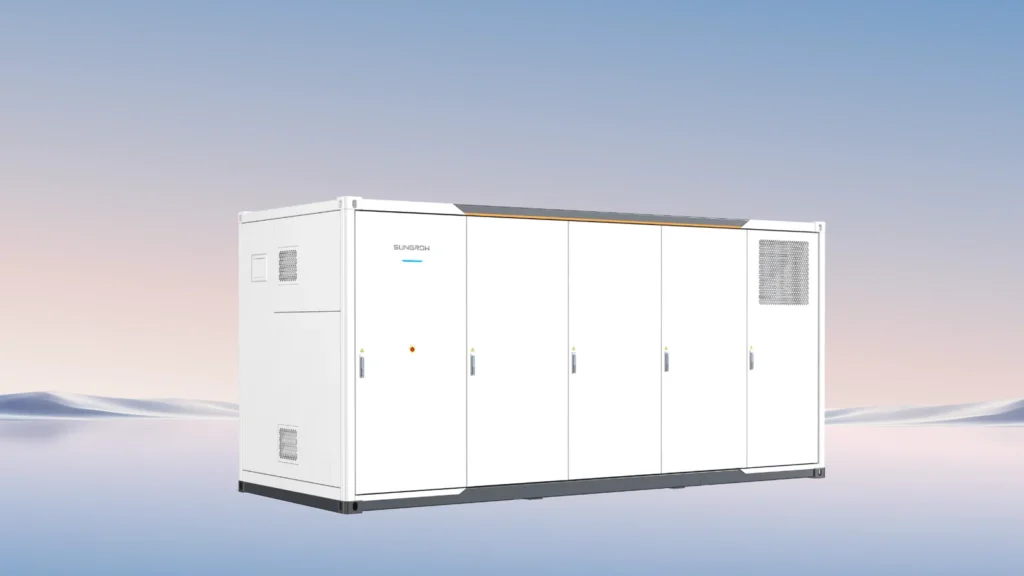
Designed to reflect block-level installation conditions in utility-scale projects, the test combined a fully liquid-cooled PowerTitan 3.0 system with a total capacity of 28.56 MWh and a 7.4 MW medium-voltage station (MVS). PowerTitan 3.0 uses an integrated AC block architecture that houses the battery system and the DC/AC power conversion unit in a single 20-foot container.
To evaluate the safety design under worst-case conditions, the test was run at 100% state of charge. The ignited container and the adjacent unit were placed back to back at close spacing, and the MV station was included in the setup. Active fire suppression and thermal management systems were disabled, while the pressure relief panels on the roof of the ignited container were left fully open to maximise ventilation and oxygen supply. Smoke and combustion gases were collected and treated in a dedicated purification system.
7.5 hours of monitoring, structural integrity maintained
After 7.5 hours of continuous monitoring, it was confirmed that thermal runaway did not spread from container A to neighbouring containers or the MV station. The highest cell temperature measured in adjacent containers stayed below the thermal runaway threshold defined under UL 9540A: 2026.
Sungrow reports that container A retained its structural integrity despite the high temperature and long fire duration and could be lifted in one piece after the test. No deformation occurred in neighbouring containers B, C, D and E.
Three generations, same result
Following PowerTitan 1.0 and 2.0, the third-generation PowerTitan 3.0 also passed a large-scale fire test on the first attempt. Sungrow says this has allowed it to build a database covering thermal runaway and fire behaviour across three product generations. Before the physical test, the system was assessed on the company’s simulation platform under hundreds of application scenarios and operating conditions; the predicted fire intensity and development trends closely matched what was observed in the physical test.
Roger Li, General Manager of the Utility-Scale Product Line at Sungrow’s Energy Storage Business Unit, said safety in energy storage is not only about cell safety but the result of cell performance, system integration, thermal management, structural protection and engineering design working together.
Benjamin Liu, Engineering Manager at UL Solutions, said the results show that the system design was able to contain the fire and prevent its spread, which can significantly reduce the scale of potential losses.
Sources
- Sungrow press release, “Sungrow’s grid-scale ESS solution PowerTitan 3.0 passes large-scale fire test”, 30.10.2026 (received by e-mail via Novo PH).
Image: Sungrow

Author