


Contents
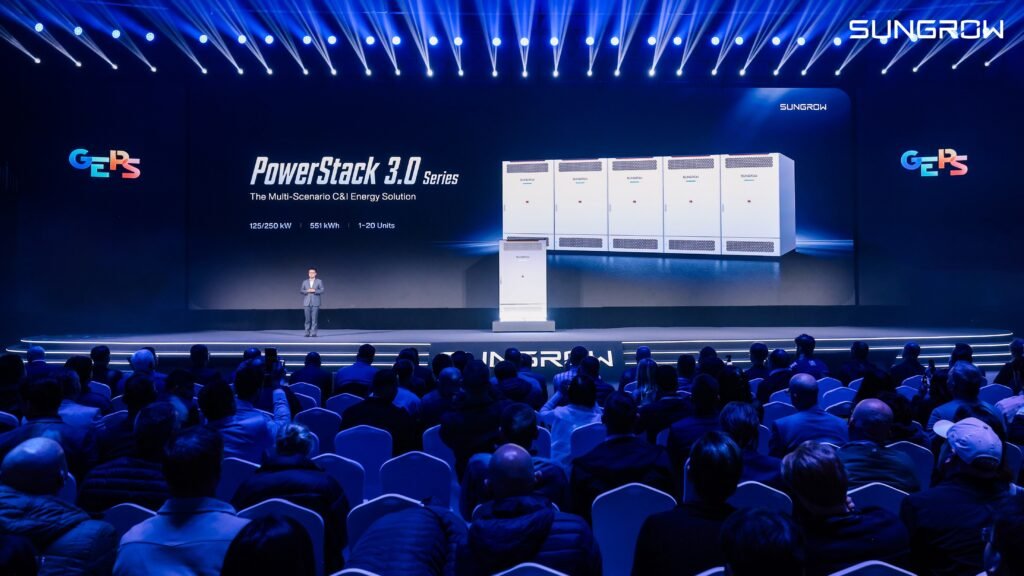
Sungrow has launched PowerStack 3.0, its next-generation commercial and industrial (C&I) energy storage series, for the global market. Unveiled at the Global Energy Pioneer Summit (GEPS) 2026, according to a statement issued from Hefei, China, on 11 November 2026, the series moves away from all-in-one physical integration towards what the company calls a “Scene-in-One” approach, in which the system is configured around a specific application.
One dock, four application modules
At the core of the platform is a multi-scenario dock that Sungrow describes as an industry first. It accepts four dedicated modules, covering PCS, solar, EV charging and microgrid functions, so that one hardware family can serve several revenue models:
- Standalone storage: different combinations of PCS power modules let the system switch between 2-hour and 4-hour durations, reducing the number of product variants that need to be stocked.
- Solar-plus-storage: with the solar module, the storage PCS also handles PV conversion, turning the unit into a DC-coupled system without an additional inverter.
- Solar, storage and charging: the EV charging module provides DC coupling across the whole PV, storage and charging chain, which Sungrow says cuts installation and integration work.
- Microgrid: the microgrid module keeps critical loads supplied during outages, with a 0 ms transfer from grid-connected to off-grid operation and no separate static transfer switch (STS) cabinet.
AI support from design to maintenance
PowerStack 3.0 ships with Bubbly, Sungrow’s in-house AI assistant. According to the company, Bubbly combines satellite imagery with 3D modelling to produce a design proposal, including layouts and financial calculations, in 30 seconds, and automates configuration and data checks to complete commissioning in 3 minutes. Its dispatch strategy, which co-optimises self-consumption, demand control, arbitrage and frequency regulation using PV and load forecasts, is said to lift returns by more than 12 percent compared with a conventional self-consumption mode. A maintenance agent monitors the system around the clock, flags more than 30 potential risks and can deliver a fault diagnosis report for a 10 MWh plant in one minute.
Key specifications
Sungrow quotes an energy density of up to 256 kWh per square metre. The units can be installed side-by-side, back-to-back or face-to-face, with up to 20 connected in parallel. For a 5 MWh plant, the footprint is 43 percent smaller than with the previous generation. The units are rated IP55 for ingress protection and C5 for corrosion protection, operate from -30°C to 50°C and tolerate up to 30 percent grid harmonics.
A self-developed silicon carbide (SiC) PCS reaches a peak conversion efficiency of 99.2 percent and, combined with 684 Ah stacked cells, gives a round-trip efficiency above 92 percent. Protection includes three-level fusing and a four-layer fire safety design.
“Today, we have entered the 3.0 era—the scenario-driven era,” said Dr. Cao Wei, general manager of Sungrow’s C&I ESS product line. “Sungrow brings you more than a new product. We bring a complete ecosystem solution: designed for every scenario, powered by intelligence and connected across the entire value chain.”
Sources
- Sungrow, “Sungrow Unveils PowerStack 3.0, Unlocking C&I New Era with Scene-in-One Integration”, press release, 11 November 2026 — sungrowpower.com
Image: Sungrow

Author