


Contents
Adding wind to solar and battery systems significantly reduces the battery capacity needed to meet 90% of electricity demand hour by hour, according to “Harnessing the winds”, an analysis published by energy think tank Ember on 13 November 2026. In Europe, the required storage falls from 20 hours of load to 12 hours; in China, from 18 hours to 12. The Global Wind Energy Council (GWEC), which partnered with Ember on the analysis, announced it on 13 November in Antalya, host of COP31.
Less battery, lower cost
Ember calculates that adding wind to solar and batteries lowers the global median cost of meeting 90% of demand from $105 to $86 per megawatt-hour, a reduction of about $20/MWh. GWEC said that because solar and wind fill each other’s gaps, less battery storage is needed and reliable renewable electricity becomes cheaper. The median cost of firm solar and wind power covering all demand, with batteries and a little backup, is put at $89/MWh.
The 90% benchmark refers to the share of demand a system meets hour by hour from its own solar, wind and batteries. Where fully firm power is the goal, the remaining hours are covered by gas or diesel backup. Ember stresses that the costs assume flat baseload demand and are a stress test, not a forecast.
Ember also notes that financing changes the picture: using each region’s own cost of capital, the median cost of 90% uptime with wind rises from $99 to $104/MWh in Europe and from $76 to $126/MWh in Africa.
Bad weeks for solar and wind rarely coincide
According to Ember, weeks in which solar output stays below half its average for seven days occur roughly four times a year globally on a demand-weighted basis, and wind lull weeks roughly eight times a year. Weeks in which both lull at the same time occur only about once every four years. In Europe, almost all solar lulls fall between November and February, while only one in eight wind lulls does.
GWEC said wind makes renewable electricity more reliable by reducing the risk of prolonged periods when both sources produce less power.
Planned coal and gas capacity
The world has 845 GW of coal and gas capacity in planning. Ember finds that, at the 90% benchmark, adding wind raises the share of this planned capacity located in regions where solar, wind and batteries offer an alternative for under $100/MWh from 71% to 90%. In China alone, wind brings a further 91 GW of planned coal and gas capacity into that range. Including backup, 706 GW of planned coal and gas is in regions where firm renewable electricity costs under $100/MWh; without wind, the figure is 520 GW.
“Reliable power at remarkably low costs”
Daan Walter, Principal at Ember, said that combining solar, wind and batteries means “we can deliver reliable power at remarkably low costs almost everywhere in the world.” GWEC CEO Ben Backwell said: “Generating clean, affordable and reliable electricity day and night, wind power is an essential part of any clean energy mix and the ideal complement to other renewable energy technologies.”
Regional results can be explored in Ember’s open-source interactive Wind + Solar + Battery Atlas. The report’s authors are Daan Walter, Sam Butler-Sloss, Antoine Issac and Kingsmill Bond.
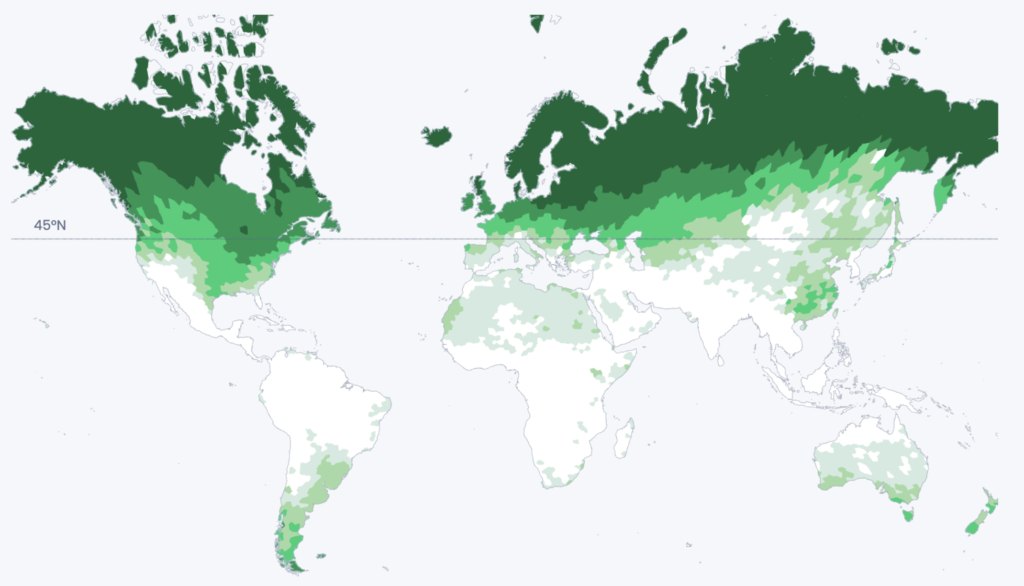
Image: Ember, “Harnessing the winds” (CC BY 4.0)
Sources
- Ember, “Harnessing the winds”, 13 November 2026 — ember-energy.org
- GWEC, “Increasing wind in the clean energy mix cuts the cost of electricity by nearly 20%”, 16 November 2026 — gwec.net

Author